Arthrostim Instrument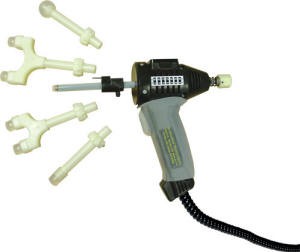
Traditionally, the
chiropractic adjustment consists of a single high-energy trust or pulling movement in
order to adjust an area of the body in order to help stimulate a healing process.
Through the adjustment a series of events are set into motion...
the precise movements, produced by the adjustment, stimulate
'neural receptors' in the area which, in turn, produce nerve impulses that relay crucial information to the
brain.
It is this 'neurological feedback stream' that the
brain relies upon in order to update its awareness about the areas of the body.
Upon evaluation of changes, produced by the adjustment, the brain issues self-correcting commands to the muscular
system, and other tissues, to bring about healing changes.
There have been recent developments in new ways to produce this
important neurological feedback stream. The Arthrostim Instrument is one new way of creating this valuable
input into an area and offers modern chiropractic many benefits for health-conscious people, using advanced
technology to make adjustments an enjoyable as well as rewarding experience.
The Arthrostim Instrument can deliver 1 or up to 12-14 rapid
series recoiling thrusts per second which works with the natural feedback cycle of the nervous system.
The results are an extremely comfortable yet highly effective adjustment.
The effectiveness comes from the instruments controlled repetitive input,
producing a cumulative 'snowballing' effect on the neural receptors.
Therefore the Arthrostim Instrument can create extensive neurological feedback
to the brain though using greatly reduced forces.
These thrusts
create a barrage of nervous system stimulation to the brain which can help reset dysfunctional muscular and
skeletal patterns.
I use this instrument to mobilize joints of the spine and extremities and for acute muscular spasms as a way to
increase muscular metabolism to release muscular contraction.
Apractitioner using the Arthrostim Instrument can maintain the effectiveness
of the adjustment while reducing the amount of force that is applied.
Using this dynamic combination a wider range of conditions can be managed more comfortably by the practitioner.
Although the Arthrostim Instrument is of much benefit to all individuals, the following
individuals could especially benefit from the use of the Arthrostim Instrument:
 Individuals who are afraid or dislike having the
spine 'cracked' Individuals who are afraid or dislike having the
spine 'cracked'
Individuals with Disc problems or related spinal
conditions
Individuals who cannot tolerate traditional
adjustments
Individuals with osteoporosis
Individuals who are in acute or chronic
pain
Young children and infants
Elderly Individuals
Individuals with arthritic
conditions
| 

 Delicious
 Digg
Digg Facebook
 Google Bookmarks
 Newsvine
 Stumbleupon
 Yahoo My Web